Transforming power grid monitoring with AI
Laki Power, an Icelandic-based company, has been at the forefront of revolutionising power grid monitoring solutions since its inception in 2015.
The project in brief
Laki Power partnered with Itera to leverage machine learning to improve its ice-monitoring services, enabling more accurate icing forecasts and real-time ice-load measurements.
This proactive approach reduces costs associated with emergency repairs, downtime, and operational inefficiencies. Grid operators can optimize their resources and minimize the need for reactive measures. Consequently, this increased efficiency can lead to financial savings.
About Laki Power
Laki Power creates line-powered monitoring systems for overhead power lines, offering innovative solutions to some of today's most pressing challenges faced by power grid operators. From monitoring icing and wildfires to optimizing grid capacity with dynamic line rating, their solutions deliver reliable, low-cost insights without needing external power sources like solar panels.
With Laki Power, operators can access critical information in real-time and generate events based on data from multiple sensors and cameras. Through Laki Analytics Studio, an all-in-one software solution for transmission line insights and analysis, operators get access to real-time monitoring of icing and wildfire events.
De-Icing methods in power grid monitoring
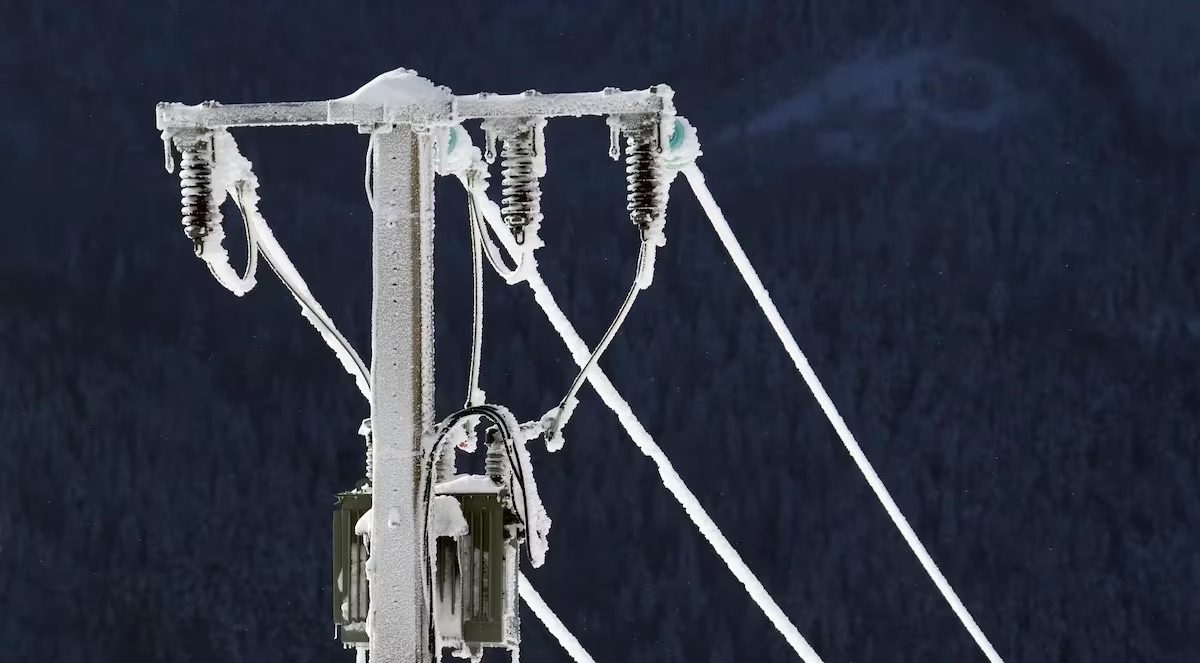
To prevent icing on power cables, power grid operators employ various de-icing methods, categorized as mechanical de-icing and thermal de-icing. When icing starts to form or has already formed on the power lines, grid operators typically respond to address the issue.
A widely used mechanical de-icing method involves helicopters removing ice from the power lines. While effective, this approach is expensive due to operational costs and logistical complexities.
In contrast, power flow de-icing is a thermal de-icing method that increases the load current. By leveraging the principle of Joule heating, which generates heat when electrical current flows through a conductor, this method helps melt ice. The load current is dependent on the power demand from customers. During periods of high demand, the current naturally increases, generating more heat in the lines and aiding in de-icing to some extent.
When employing de-icing methods, it is important to consider multiple parameters to maintain a balanced system and ensure that power lines do not exceed their thermal limits. This is where Laki Power's monitoring station plays a crucial role. By providing real-time conditions of the power lines and utilizing cameras to assess ice build-up, the monitoring station assists grid operators in monitoring the effectiveness of de-icing efforts.
From manual interpretation to automation
The collaboration with Laki Power and Itera's AI experts marked a significant shift in data analysis – from manual interpretation to automation in monitoring. Initially, Laki Power's monitoring devices presented data that required manual interpretation of data, including the final verification of icing events through image inspection.
The Itera team wanted to extract meaningful insights from the vast amount of data collected by Laki Power's monitoring devices. The Itera and Laki Power teams collaborated on the integration of AI technology aimed to automate this process, therefore enhancing the delivery of actional information in real-time.
How the Analytics Studio works
The system provides customers with a user interface displaying three images:
- Showcasing the power lines
- Offering a view of the ground
- Presenting a mast view
These images are captured every 30 seconds and accompanied by environmental measurements such as wind speed, wind direction, humidity, ambient temperature, and accelerometer recordings of the power line's pitch and roll.
From Laki Power's visit to the Itera office in Oslo. From left to right: Justyna Ozog (Data Scientist/Developer, Itera), Inga Stefánsdóttir (Head of Research and Analytics, Laki Power), Marius Landsverk (Data Scientist, Itera)
What we did
The first task that Itera's team did in conjunction with Laki was to port over all the existing model logic and data to Azure. The team utilized Azure AI studio, Azure storage, virtual machines and model deployments. A multi-class classification architecture was chosen for the model to make the model more flexible, enabling it to categorize various aspects of the images, including the thickness of the ice on the power line and the presence of a corona effect.
Due to the large image size coming from the cameras, a downsampling and cropping approach was used to minimize the noise in the data. The model was a foundation model trained on the ImageNet dataset, which the team further fine-tuned on images from Laki's sensors.
The team deployed this to the cloud and incorporated a demo app for Laki with Laki's software team.
Advanced image analysis
powered by machine learning
By leveraging AI and machine learning, Laki Power's improved system predicts icing conditions and enables power grid operators to take preventive measures.
By detecting the early stages of ice formation, operators can increase the current joule flowing through the power lines, generating additional heat to melt the ice. This proactive approach minimizes the risk of ice accumulating and reduces the potential for galloping, a phenomenon where power lines sway uncontrollably due to ice and wind conditions.
Prompt notification of icing events allows operators to mobilize crews and closely monitor power lines, preventing potential damage and outages.
The ice detection algorithm was previously based on environmental and sensor measurements. By manually annotating images, we trained an image classifier that could augment the existing ice detection system.
– This project has showcased the immense potential of AI and machine learning in the power grid monitoring industry. Laki Power has already made significant discoveries by harnessing the power of data and images.
Inga Stefánsdóttir
Head of Research and Analytics, Laki Power
– This project has showcased the immense potential of AI and machine learning in the power grid monitoring industry. Laki Power has already made significant discoveries by harnessing the power of data and images.
Inga Stefánsdóttir, Head of Research and Analytics, Laki Power
– For example, now we can identify galloping events on power lines even when operators were unaware of this issue. Galloping poses a significant risk to the infrastructure's lifespan and stability, so by preventing this, the operators can save both money and the environment, continues Stefánsdóttir.
The timeline for this project has been exploratory. By this winter season, Laki Power intends to provide customers with actionable insights on icing conditions. Continuous improvements will be made, including incorporating additional weather conditions to enhance the system's accuracy and usefulness.
By leveraging advanced monitoring solutions like those offered by Laki Power, power grid operators can fulfil their role effectively, maintaining a reliable and resilient national electricity grid.
Related cases
Explore more stories from our work in data, AI and analytics
Trafsys
Behind Norway's traffic management and road safety
KLP
How Itera helped KLP set the direction for its AI work
Glamox
Data-driven solutions opened new business opportunities for Glamox
Moelven
Itera helped Moelven identify million-level potential with AI
Capture Energy
Empowering energy storage solutions with Capture Energy
Financial company
Faster onboarding of new customers
Heisrådgiveren
50% reduced time usage with digital transformation
DNB Eiendom
Collaboration for a smarter future in real estate
BAHR
Improving operational efficiency through the power of generative AI

NHO